

1870 - 1957
Pompeo Luigi Coppini
Italian-American sculptor whose monumental works define the artistic landscape of Texas. Creator of the Alamo Cenotaph and founder of the Coppini Academy of Fine Art.

Coppini in 1928
Early Life & Journey to America
Pompeo Luigi Coppini was born on May 19, 1870, in Moglia, a small community in the Province of Mantua, Italy. His family moved to Florence, where at an early age, he was influenced by a neighborhood studio that created copies of famous sculptures for tourists. At just 16 years old, he secured a place at Florence's renowned Accademia delle Arti del Disegno, studying under master sculptor Augusto Rivalta and graduating at the top of his class.
After serving in the Italian army twice and trying his hand at various occupations—tutor, hydraulic engineer, sign painter, waiter, and bookkeeper—he received a contract to work on an eight-foot marble angel destined for a cemetery in Boston. In 1896, at 26 years old, he boarded a ship bound for New York with nothing but $40 and a trunk of clothes.
Historical accounts describe how he ran out of money fast, going six days without food and nearly perishing before a kind Italian woman took pity on him. Yet despite these early hardships, when Coppini came to America, he adopted it as his true home and was deeply dedicated to his new country. He adored the place.
In New York, Coppini worked at a local wax museum sculpting figures and collaborated with established sculptors on major projects, including the Fountain of Neptune at the Library of Congress (1897). Through artist Alexander Doyle, he worked on the Francis Scott Key memorial in Frederick, Maryland, where he met his wife, Elizabeth Maria Di Barbieri, who modeled for the piece. They would remain married for nearly 60 years.
The Texas Years
Frustrated by his lack of success in New York, Coppini accepted an opportunity in 1901 to work with Frank Teich, a German-born stonecutter based in San Antonio. He became an American citizen the following year. Coppini arrived in Texas during the City Beautiful movement, when American cities were reforming their architecture to include parks with statues and civic monuments. It was a sculptor's dream.
During the next 15 years, Coppini received numerous commissions to celebrate Texas heroes. His works were installed at the Texas State Capitol in Austin, Texas A&M University, and throughout the state. He became known for his ability to capture the spirit of heroic figures in bronze and marble.
By 1910, Waldine Tauch—a young sculptor from Schulenburg, Texas—became Coppini's student, then apprentice, and finally his partner. He mentored her in the classical tradition, and she collaborated with him until his death. Tauch became a noted sculptor in her own right, carrying on his legacy.
Major Works
Coppini created over 230 works during his lifetime, including 76 publicly displayed statues in 12 states and 3 countries. Here are some of his most celebrated pieces.

The Alamo Cenotaph (Spirit of Sacrifice)
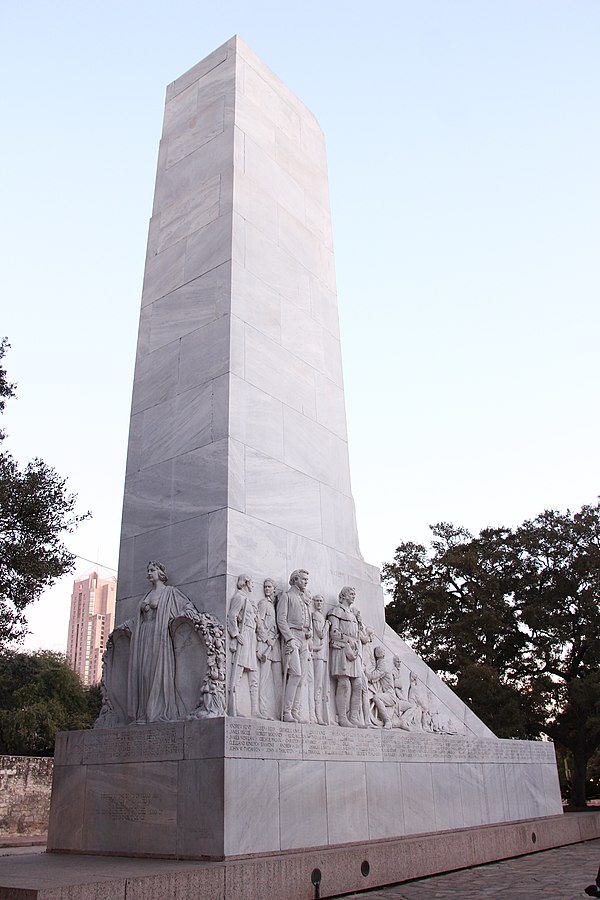
Perhaps his most famous work, this 60-foot monument honors the heroes of the Alamo including Jim Bowie, Davy Crockett, William B. Travis, and James Bonham.

Littlefield Fountain
A magnificent fountain commemorating those who lost their lives in World War I, featuring dynamic bronze figures emerging from the water.

Lawrence Sullivan Ross
One of the most revered works on campus. Students place coins at the statue's feet for good luck on exams.

Rufus C. Burleson
A tribute to the former Baylor University President, showcasing excellent lost wax casting technique.

Terry's Texas Rangers Monument
Honoring the 8th Texas Cavalry Regiment, this dynamic monument captures the spirit of the legendary Rangers.

George Washington
The third of three Washington statues Coppini created, this one stands on the south mall of UT Austin.
His Masterpiece
The Alamo Cenotaph
Dedicated in November 1940, the Alamo Cenotaph—also known as "The Spirit of Sacrifice"—is the work Coppini considered his greatest achievement. The 60-foot monument celebrates the heroes of the Battle of the Alamo.
"I know I was chosen, not only for my artistic merits, but also because of my proven love and almost fanatic admiration for the heroes of the Alamo."
The monument features heroic figures of Jim Bowie, James Bonham, Davy Crockett, and William B. Travis, carved into triangular marble panels. Coppini was in his late sixties when he completed this immense project, using a pneumatic drill to help carve the intricate figures.
Life Timeline
Born in Moglia, Province of Mantua, Italy on May 19
At age 16, enrolled at Florence's Accademia delle Arti del Disegno
Emigrated to the United States with $40 and a trunk of clothes
Worked on Fountain of Neptune at Library of Congress
Moved to Texas to work with German sculptor Frank Teich
Became a United States citizen
Completed Confederate Soldiers Monument at Texas State Capitol
Waldine Tauch became his student and protégée
Completed the Littlefield Fountain at UT Austin
Designed the Texas Centennial Half Dollar
Completed the Alamo Cenotaph
Received honorary Doctor of Fine Arts from Baylor University
Founded the Coppini Academy of Fine Art in San Antonio
Died on September 26 in San Antonio, buried in a crypt he designed
The Coppini Academy Legacy
In 1945, Coppini established the Coppini Academy of Fine Art at his studio on Melrose Place in San Antonio, where he had completed work on the Cenotaph. Today, the Academy continues his mission of promoting classical and representational art through educational programs, demonstrations, and workshops.
"When Texans think of their history, quite often the images they have in their mind are images created by Papa Coppini," noted Dr. Rick McCaslin of the Texas State Historical Association.
Continue the Legacy
The Coppini Academy of Fine Art continues Pompeo's vision today, offering classes in classical and representational fine art.